
Summarize the blog with Artificial Intelligence (AI):
 ChatGPT
 Google AI
 Grok
Grok Perplexity
 Claude.ai
Introduction: Why Most Founders Get Lead Gen Wrong
The most common mistake early stage founders make is treating B2B lead generation as a volume game – buy a list, blast an email sequence – and hope something sticks. It rarely does. B2B lead gen is about reaching the right people with the right message at the right time. Founders who chase volume end up with bloated contact lists, low reply rates and wasted hours chasing prospects who were never a fit. This guide gives you a clear, practical understanding of what B2B lead generation actually is, how it works mechanically, and how to build a consistent pipeline of quality B2B sales leads without a large team, a big budget, or disconnected tools.
What Is B2B Lead Generation?
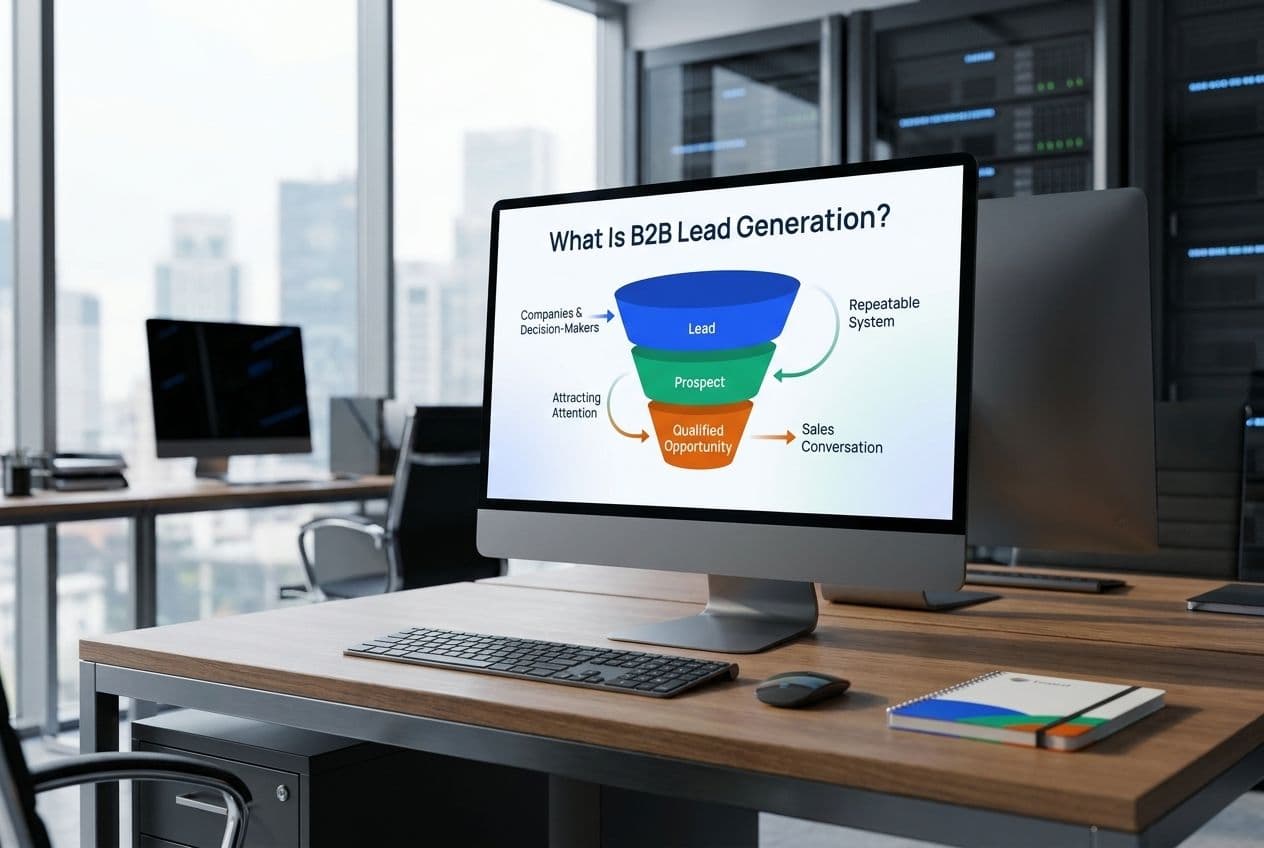
B2B lead generation is the process of identifying companies and decision-makers who could benefit from your product or service, attracting their attention and moving them toward a sales conversation. A purchased list gives you names; B2B lead gen gives you a repeatable system for creating genuine interest.
Understanding the terminology matters. A lead is any contact who has shown some signal of potential fit. A prospect is a lead confirmed to match your ideal customer profile. A qualified opportunity is a prospect who has engaged directly, has a pressing need and is actively evaluating solutions. Most B2B lead generation strategies fail because founders treat all three as identical, chasing every contact with the same energy. The goal is to move contacts deliberately through each stage, investing more effort only as fit and intent become clearer.
How B2B Lead Generation Works: The Core Mechanics
Effective B2B lead generation runs as a system, not a series of disconnected activities. It starts with a tight ideal customer profile (ICP) – defining exactly which companies and decision-makers you are targeting by industry, size, role and pain point. Without this foundation, every step that follows is guesswork.
From there, the system moves into sourcing and outreach. You identify accounts that match your ICP, research the right contacts and engage them with messaging built around their specific challenges, not your features. This is where most strategies break down: founders send generic messages to broad lists and wonder why nobody replies. Personalised outreach to a smaller, well-researched set of leads consistently outperforms volume-driven approaches.
The final stages are qualification and handoff. Not every reply signals genuine intent, so you apply simple criteria: does this prospect have the problem, the budget and the urgency to act? Those who pass move into an active sales conversation. Those who do not get nurtured until timing shifts. Each stage feeds the next, and the whole system compounds over time.
Free monthly resource
Get your regular update for B2B founders
Practical AI tactics for sales, marketing, and GTM. Unsubscribe any time.
B2B Lead Generation Strategies That Work for Founders
Outbound is where most founders start, and for good reason. Cold email and LinkedIn outreach generate leads quickly, require minimal budget and give you direct control over targeting. Expect to spend 5-10 hours weekly on research, writing and follow-up. Replies typically come within 2-4 weeks, but a consistent pipeline takes 60-90 days to build. Done right – small, well-researched lists of 20-50 contacts with genuinely personalised messaging – outbound remains one of the most reliable strategies for small teams. Volume without relevance kills response rates; relevance without volume kills momentum.
Inbound approaches, primarily search engine optimisation (SEO) and content marketing, build compounding assets that generate leads while you sleep. Organic search typically takes 3-6 months before meaningful traffic arrives. For founders who can commit to consistent publishing around their buyer's real questions, inbound becomes the most cost-efficient channel long term. A single well-ranked article can generate qualified leads for years and builds credibility that accelerates every outbound conversation in parallel.
Account-based approaches focus your limited energy on a short list of high-fit target accounts, coordinating outreach across email, LinkedIn and content simultaneously. This is the highest-effort strategy upfront but produces the strongest conversion rates because every touchpoint is tailored. Reserve it for 10-20 dream accounts where deal size clearly justifies the investment.
Cold email — Effort: Medium · Budget: Low · Time to results: 4-8 weeks
LinkedIn outreach — Effort: Medium · Budget: Low · Time to results: 4-8 weeks
SEO/content — Effort: High · Budget: Low/medium · Time to results: 3-6 months
Account-based — Effort: High · Budget: Medium · Time to results: 6-12 weeks
Tools v Motion: What You Actually Need
Most founders solve a lead generation problem by buying tools – a contact database here, an enrichment platform there, an email sequencer on top. Before long, you're paying for four subscriptions that don't talk to each other. Tools like ZoomInfo or Apollo provide raw contact data. If you need a large verified list quickly, they do that job well. But a database is not a go-to-market (GTM) motion. It gives you names; it does not give you pipeline.
RevGeni is not a contact database and does not replace one. What it handles is the motion around your lead generation: sourcing ICP-fit accounts, researching prospects, personalising outreach and managing sends – with you approving before anything goes out. If your problem is "I need 50,000 raw contacts," that is a different category. If your problem is "I need qualified conversations without building a sales-ops function", that is where a GTM motion tool earns its place.
Your First 30 Days: A Practical Starting Point
Start with your ICP – write down exactly which company type, size and role you are targeting. Then pick one channel only, LinkedIn outreach or cold email. Build a simple 3-step sequence: a personalised opening message referencing a specific pain point, a follow-up adding genuine value and a short final ask. Contact 20-30 well-researched prospects per week consistently. After 30 days, measure reply rates and conversations booked – the numbers tell you exactly what to fix. Ready to build this into a repeatable system? Download the Founders Playbook.
Frequently Asked Questions
What is the difference between B2B and B2C lead generation?
How long does B2B lead generation take to show results?
Do I need a big team to do B2B lead generation?
What is the best B2B lead generation strategy for early-stage founders?
Do I need to buy a contact database to generate B2B leads?
Free monthly resource
Get your regular update for B2B founders
Practical AI tactics for sales, marketing, and GTM. Unsubscribe any time.