
Summarize the blog with Artificial Intelligence (AI):
 ChatGPT
 Google AI
 Grok
Grok Perplexity
 Claude.ai
The Specialist CRM Decision Facing Many Businesses
Almost half of all CRM implementations fail in some meaningful way, with failure rates ranging from 30% to 60% across deployments [1]. Most founders assume the culprit is technical: a bad integration, a rushed rollout, or a vendor that overpromised. However, the most commonly cited causes are adoption failures and misalignment between system design and actual workflow, as opposed to fundamental product shortcomings. In other words, you can experience a flawless implementation and still end up with a tool your team quietly works around, logging deals in spreadsheets or defaulting to email threads because the CRM simply does not match how work actually gets done.
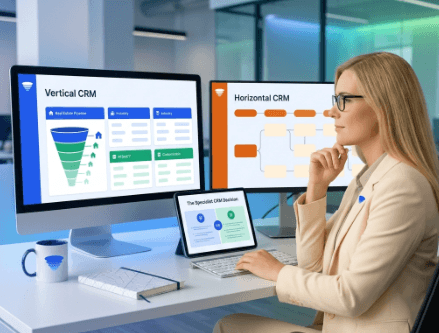
That misalignment can often be traced back to a decision made early on: choosing between a vertical CRM built for your specific industry and a horizontal platform designed for everyone. A real estate team tracking commission splits and property pipelines has fundamentally different needs than a SaaS company managing subscription renewals and expansion revenue. The vertical CRM vs horizontal CRM question sounds straightforward, but most founders treat it as a features comparison when it is really a workflow question. Does the system reflect how your team actually operates, or does your team have to adapt to fit the system? That distinction, more than any feature checklist or pricing tier, determines whether your CRM investment delivers measurable returns or quietly drains time, budget, and momentum.
The Hidden Customisation Tax of a Generic CRM
When a founder selects a horizontal CRM for a specialist vertical, the licensing cost is just the entry fee. Industry estimates show that customisation spend typically runs at 2.5 to 4 times the original licensing cost over three years, driven by consulting overruns, custom development, and mounting administrative overhead [1]. None of that appears as a line item in the original business case. The true cost is invisible at the point of purchase, distributed across budget lines that are easy to misattribute, appearing instead as IT project spend, third-party consulting fees, or internal staff time that never gets taken into account.
The integration burden compounds this further. Organisations requiring multiple custom integrations on a generic platform typically spend about a third of their entire CRM admin budget on maintaining data flow and accuracy. That is not a one-time project cost. It is a recurring liability that grows as the business scales, consuming the capacity of the people who should be improving your pipeline. Every system update, API change, or new data requirement creates another round of remedial work that quietly drains engineering and operations resources.
There is also a coverage gap that rarely features in vendor demos. Generic CRM integrations typically address around 70% of industry-specific use cases, leaving the remaining 30% to custom development that must then be maintained indefinitely [1]. This is precisely where friction kills adoption and erodes the return on your original investment.
Why Vertical CRMs Can Win on Time-to-Value
The adoption numbers here are stark. An industry-specific CRM matched to its vertical reaches full adoption in an average of 5 months, compared to 11 months for a general CRM in standard deployments and up to 19 months in complex verticals like legal, pharmaceuticals, and construction. The path to positive ROI follows the same pattern: vertical CRMs hit that threshold at around 8 months, versus 14 months or more for general platforms [1]. In many cases, that gap is an entire fiscal year of delayed returns - a significant cost when you factor in licensing fees, consultant hours, and lost productivity during the transition period.
It is important to avoid dwelling on symptoms and to focus on the causes. A key driver is the pre-built data model. A specialist CRM for healthcare tracks "Patients" and "Referrals." A generic platform tracks "Leads" and "Opportunities." Those are not cosmetic differences - the data structure shapes every screen, workflow, and interaction. Industry-specific CRMs are estimated to reduce configuration scope, and can address around 90% of core requirements out of the box. That remaining 10% typically involves edge cases and firm-specific preferences rather than foundational structural gaps.
Ultimately, adoption is driven more by recognition than by features. When a clinician, recruiter, or financial adviser opens a CRM and immediately sees terminology that reflects their actual work, the cognitive barrier reduces. Generic sales language mapped awkwardly onto specialist workflows causes disengagement.
The practical implication for CRM for specific industries is this: a vertical CRM does not win on time-to-value because it has more features. It wins because it eliminates the translation layer between how your team thinks and how the system is structured. That alignment is what drives adoption, and adoption is what determines whether any CRM investment returns anything at all.
Example
Knockio is a field sales and service CRM for the trades. Territories are drawn on the map or generated from a ZIP code and assigned to specific reps, and scanning one returns the properties inside it, so a rep starts the day with a list of addresses instead of a blank pipeline. Rather than typing an address into a form, they tap the property on the map and Knockio creates the lead with the address already filled in. Routes get planned across those territories, and campaigns keep two teams working the same area out of each other's pipelines. Lead statuses are set to match how the business actually sells, and leads move along a board as they progress. Appointments, work orders, the product catalog, invoices and payments all run in the same system, on that same record. There's very little to set up to make any of it match how a field team works. That's usually the difference between a CRM getting used and one that gets worked around.
Free monthly resource
Get your regular update for B2B founders
Practical AI tactics for sales, marketing, and GTM. Unsubscribe any time.
How to Make the Right Call: A Practical Framework
The decisive criterion in the vertical CRM vs horizontal CRM debate is how standardised your workflows are within your industry. Start with a process audit before you evaluate any platform. Ask honestly: does your pipeline logic mirror the industry norm, or does it reflect genuinely proprietary decisions that differentiate how you compete? If your workflows are largely standard, a specialist CRM built for your vertical will serve you accurately and efficiently. If your competitive advantage lives inside those workflows, a pre-built template will constrain rather than enable you. This distinction is highly likely to be more important than company size, budget, or technology preference.
Horizontal wins in three clear scenarios. First, when your pipeline logic is a genuine competitive differentiator that no vendor's data model should template. A bespoke sales methodology or a unique client segmentation approach, for instance, may lose its integrity when forced into a pre-configured structure. Second, when you operate across multiple divisions or verticals, where no single industry-specific CRM can adequately serve the full operation. Third, when talent availability matters, because the depth of the Salesforce and MS Dynamics ecosystems reduces key-person risk in ways that niche vertical platforms simply cannot match [1]. If any of these apply, the extensibility of a horizontal platform outweighs its customisation cost.
A vertical CRM earns its place in regulated industries with standardised processes, adoption-critical environments where terminology drives daily buy-in, and verticals where compliance frameworks like HIPAA or KYC represent baseline operational requirements rather than optional configuration. Healthcare, financial services, life sciences, and legal services all meet this test. In these contexts, the time-to-value gap is too significant to ignore, and the structural compliance alignment reduces risk that horizontal platforms require you to build and maintain independently at considerable ongoing cost.
The hybrid path is technically viable but genuinely demanding. Combining a horizontal platform as an executive reporting layer with vertical systems as operational records of truth can serve complex enterprises well, but it requires mature data governance, capable IT structures, clearly defined integration ownership, and sustained investment to maintain. Without these foundations in place, the hybrid model introduces data inconsistency and operational friction rather than resolving it. It is not a sensible default compromise for most mid-market organisations. Whichever path you choose, the starting point is the same: audit your processes first, then evaluate platforms. The system should fit how your team actually works - not the other way around.
Frequently Asked Questions
When does a specialist CRM make more sense than a generic one?
What does it actually cost to customise a generic CRM for a specialist industry?
Can a horizontal CRM realistically work in a regulated or complex vertical?
Free monthly resource
Get your regular update for B2B founders
Practical AI tactics for sales, marketing, and GTM. Unsubscribe any time.