
Summarize the blog with Artificial Intelligence (AI):
 ChatGPT
 Google AI
 Grok
Grok Perplexity
 Claude.ai
Introduction: a new category worth understanding
The average founder now juggles over a dozen AI tools, yet go-to-market results remain stubbornly inconsistent. More subscriptions, more dashboards, more prompts – and still a leaky pipeline. The problem is not your lack of effort. It is that most AI tools require you to drive them. You prompt, they respond, and the work lands back on your plate.
That is the core question worth asking before adding anything new to your stack: is an AI growth agent simply another tool you operate, or something that operates alongside you? Understanding what agentic AI actually means – how an AI agent for growth reasons, plans and acts across multi-step tasks without constant hand-holding – changes how you evaluate every solution in the category.
Think about the difference between a calculator and a financial analyst. Both work with numbers, but only one can interpret context, identify problems you did not think to ask about and recommend a next step. Agentic AI sits closer to the analyst end of that spectrum. It can monitor your pipeline, identify a drop in conversion between two specific stages and trigger a targeted response sequence–v without waiting for you to notice the problem first. That shift from reactive tool to proactive system is what makes this category worth understanding before your competitors do.
What is an AI growth agent?
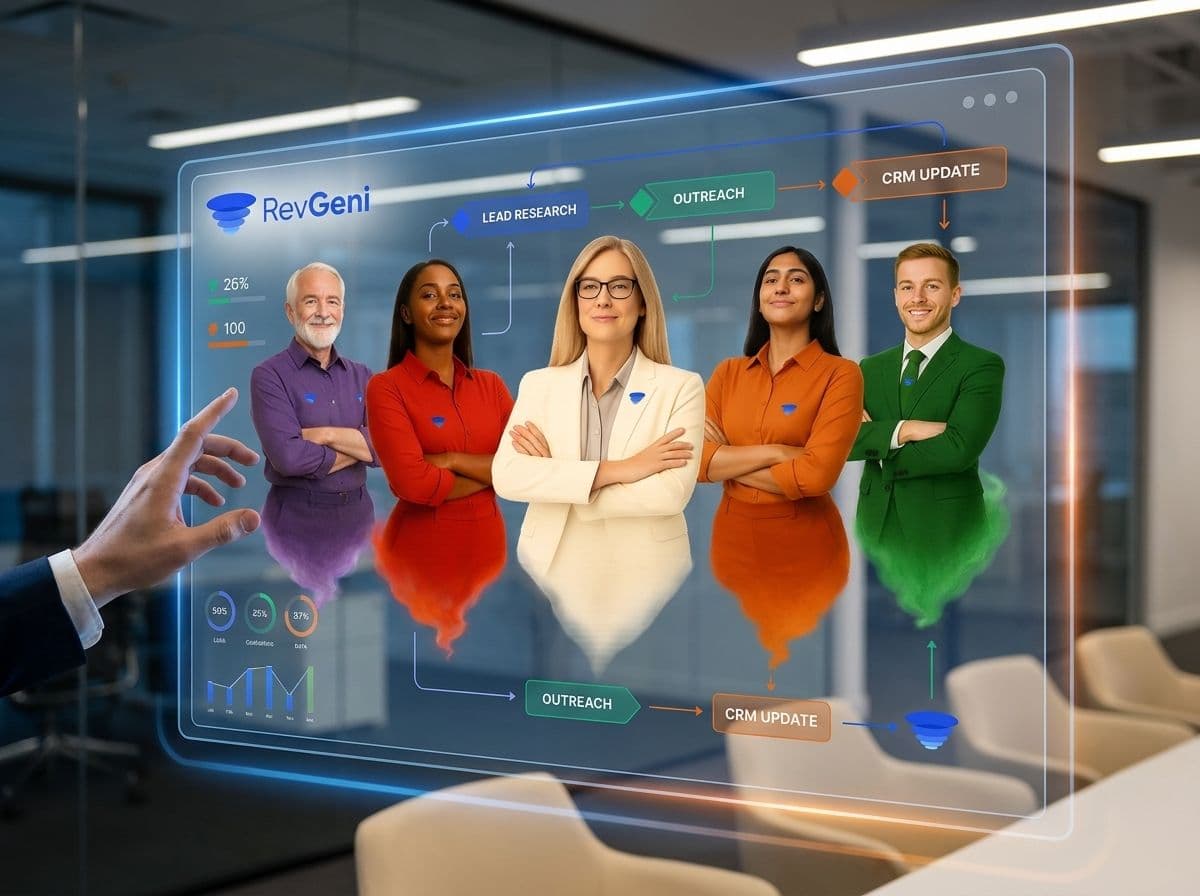
An AI growth agent is an autonomous system designed to execute go-to-market work, not just respond to prompts. Where a standard AI tool waits for your input, a growth agent reasons through a goal, breaks it into steps and acts – researching a target account, drafting personalised outreach, updating your CRM and triggering a follow-up, all without you managing each step.
This is precisely what RevGeni's Genies are built to do. Each Genie is a pre-built AI agent for growth, purpose-designed for a specific GTM function – lead research, content creation, meeting preparation or pipeline updates. Rather than a general-purpose AI you configure from scratch, a Genie arrives with context, workflow logic and clear outputs. A meeting preparation Genie, for example, automatically pulls together a prospect's recent news, funding history and likely pain points before a call – no manual prompting required. As a founder running a lean team, you are not learning a tool; you are deploying a system that already knows its job.
The keyword is ‘autonomous’. Picture a capable new hire who can monitor your pipeline, spot a stalled deal and send a targeted follow-up before you even notice the problem. That is what separates a growth agent from a chatbot or point tool. It holds context across tasks, makes decisions within defined boundaries and moves work forward consistently – even when your attention is elsewhere.
AI growth agent vs chatbot: what's the difference?
The simplest way to explain it is to say that chatbots respond, agents act. A chatbot, including ChatGPT in standard form, is reactive. You provide a prompt, it returns an output, and the exchange ends. Each interaction starts from zero, with no memory of your pipeline, no awareness of your goals and no next step taken unless you ask.
An AI growth agent operates on entirely different logic. It holds context across a workflow, pursues a defined goal and takes sequential action. You ask ChatGPT to write a follow-up email and it does. A growth agent monitors your pipeline, identifies a prospect who has gone cold, researches their recent activity – a funding announcement, a LinkedIn post, a job listing – and sends a personalised follow-up automatically. One is a single-turn exchange. The other is a multi-step system doing the work between your conversations, continuously, without being prompted.
This distinction matters most for founders running lean. If you already use ChatGPT, you know the value of the output, but you also know the hidden cost: you are still the engine. You notice the problem, write the prompt, review the draft, copy it into the right tool and decide the next action. The bottleneck has not moved; it has just shifted slightly. Understanding how AI agents work reveals what you are actually missing – not better answers, but a system that moves go-to-market work forward without you driving every step.
Free monthly resource
Get your regular update for B2B founders
Practical AI tactics for sales, marketing, and GTM. Unsubscribe any time.
AI growth agent vs point AI tools
Point tools solve one problem cleanly, and that is genuinely useful. Buffer schedules social posts. Lusha surfaces contact data. A content generator drafts copy. Each does its job well in isolation. But your GTM motion is not isolated. Research feeds messaging, messaging drives outreach, outreach triggers follow-up, and follow-up informs your next campaign. When each tool operates independently, you become the connective tissue – manually copying outputs from one platform, pasting them into the next, hoping nothing gets lost in the handoff.
That is the gap an AI growth agent closes. Rather than handling a single step, it operates across the entire go-to-market workflow as a unified system – researching a target account, shaping the outreach angle, executing the sequence and queuing follow-up based on response behaviour, without you stitching steps together. The intelligence lives in the connections, not just the individual actions.
The practical difference shows up in your calendar and cognitive load. With point tools, you still manage the workflow, track where each prospect sits and decide what happens next. With an AI agent for growth, the workflow manages itself within boundaries you set upfront. A founder running a small team cannot afford to be the integration layer between six disconnected platforms. What agentic AI means here is straightforward: one system that holds context across your entire pipeline, acts on it consistently, and frees your attention for decisions that actually require you.
Is an AI growth agent right for your team?
If you are a solo founder or running a team of under 10, the answer is: probably yes. The clearest signal is that your go-to-market work is inconsistent or entirely dependent on your personal bandwidth. You know what needs to happen – outreach, follow-up, content, pipeline hygiene – but it moves only when you push it. An AI growth agent replaces the need for a full hire by holding that motion together autonomously. You set the boundaries; the agent executes within them, consistently, without needing you to prompt every step.
If your best outreach weeks happen only when you personally clear your calendar, that is a capacity problem an agent can directly solve. It runs the same disciplined process whether you are heads-down on a product sprint or closing another deal.
That said, not every team is ready. If you have no defined ICP, no clear outreach process and no CRM data worth acting on, an AI agent for growth will automate chaos rather than create momentum. The right fit: you have a repeatable sales motion but lack the capacity to run it consistently. Get the foundations right first – a working ICP, a proven message, a basic pipeline structure – then deploy an agent to scale what already works. That distinction, between amplifying a system and replacing the thinking behind one, is what agentic AI actually means in practice.
Frequently Asked Questions
What is an AI growth agent?
How does an AI growth agent differ from a chatbot?
How does an AI growth agent differ from standard AI tools?
Is an AI growth agent right for a small or solo team?
How do I get started with an AI growth agent?
Free monthly resource
Get your regular update for B2B founders
Practical AI tactics for sales, marketing, and GTM. Unsubscribe any time.