
Summarize the blog with Artificial Intelligence (AI):
 ChatGPT
 Google AI
 Grok
 Perplexity
 Claude.ai
What Is an AI Agent, Really?
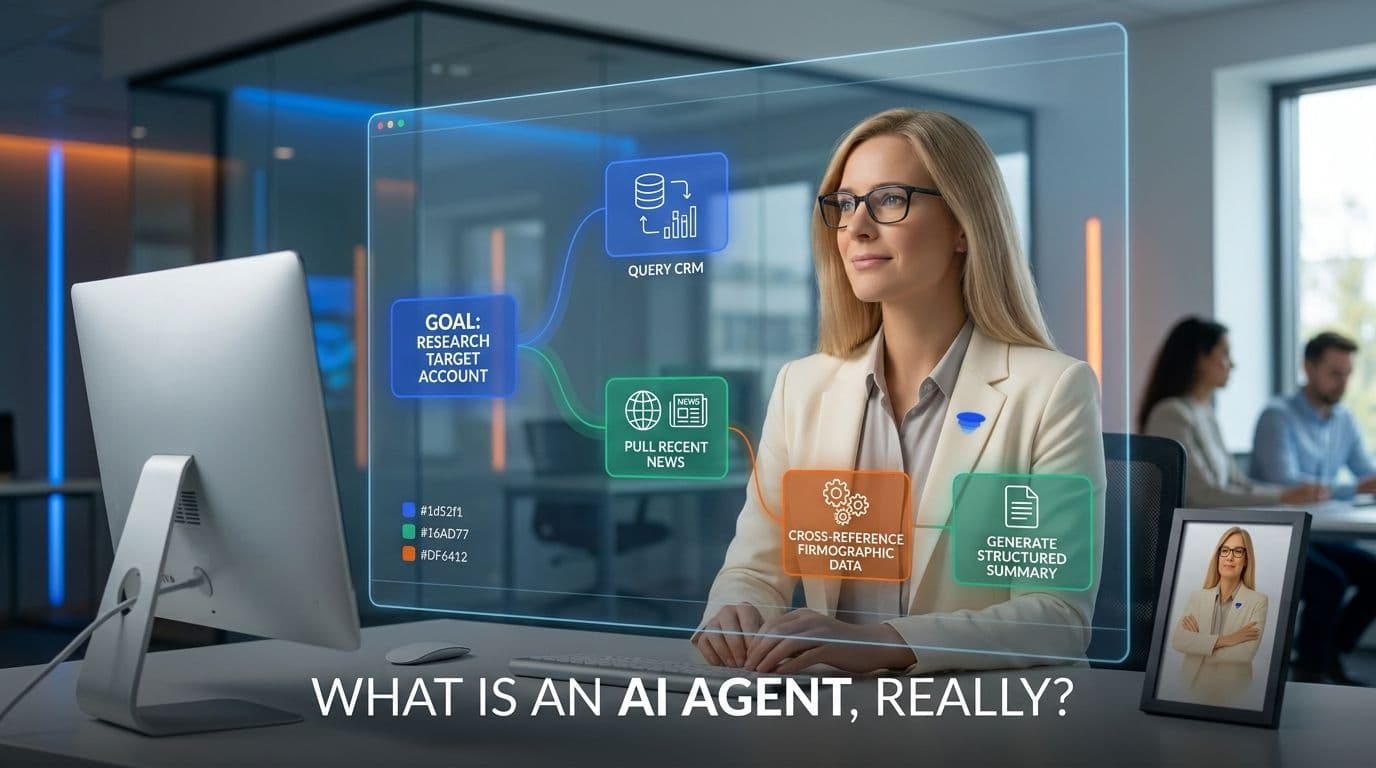
An AI agent is software that pursues a defined goal through a sequence of decisions, not just a single response. Unlike a chatbot, which waits for your next prompt, or basic automation that follows a fixed script, an agent assesses its context, selects from available tools and works through multiple steps to complete a task.
Say you brief an agent to research a target account. It queries your CRM for existing contact data, pulls recent news about the company, cross-references firmographic information and returns a structured summary, all without you specifying each step. That shift from reactive to goal-directed behaviour is what makes agents meaningful for B2B teams, and it is what the rest of this guide unpacks.
AI Agents vs Chatbots vs Automation: What’s the Difference?
Rule-based automation executes a fixed sequence of steps when specific conditions are met – “if a form is submitted, add the contact to this CRM list”. It is fast and reliable, and suits high-volume, low-variation tasks such as invoice processing, data syncing or scheduling follow-up emails. But it is entirely rigid and cannot cope when something unexpected occurs.
Traditional chatbots sit one step up, responding to inputs through decision trees or basic language matching. They are practical for answering FAQs, qualifying inbound leads or routing support queries, but they handle one exchange at a time and tend to stall or fall back on generic replies when a conversation goes off-script.
An agent interprets a goal, chooses the tools it needs and works through the steps. Because it can make decisions based on intermediate results, it adapts its approach to what it finds rather than follows a predetermined path.
How AI Agents Actually Work
Every agent starts with a goal. It then reads its context: the tools it can use, the data available and the constraints it must respect. From there, it reasons through the problem, deciding what to do first and how to sequence its actions.
In other words, to complete the task, the agent calls on tools such as your CRM, web search, a document library or an email platform. It interprets what each returns and uses the results to inform its next step. If it discovers information mid-task (for instance, a recent acquisition), it can fold it into its output rather than ignore it.
Approval gates keep consequential decisions with people. The process pauses so a human can review before anything is sent, updated or published.
Free monthly resource
Get your regular update for B2B founders
Practical AI tactics for sales, marketing, and GTM. Unsubscribe any time.
Where AI Agents Add Real Value in B2B
For lean B2B teams, the biggest drag on productivity is the preparatory work that sits between a good idea and its execution: lead research, CRM updates, meeting prep, content drafting. These tasks are necessary, repeatable and time-consuming, and they rarely need senior judgement but consistently consume it.
Sales: The clearest application is account research. An agent can pull firmographic data, surface company news, check CRM records, flag incomplete fields and draft an initial outreach message. A rep who would spend 40 minutes researching five accounts manually can review five prepared briefs in 10 minutes instead, starting from a foundation rather than a blank page.
Marketing: An agent can gather competitor messaging, summarise audience data, pull performance metrics and produce a working draft from a brief. For a small team stretched across several campaigns, refining something solid rather than starting from scratch changes what is achievable in a week.
Coordination: Scheduling, follow-up sequencing, meeting summaries and cross-tool data alignment are rarely anyone’s priority, yet cause friction when neglected. Because this work is high volume and low ambiguity, agents handle it especially well, and the value compounds quietly.
Across all three areas, the agent absorbs preparation and administration, and your team decides what gets sent.
What People Must Still Own: The Human Oversight Argument
Agents are not autonomous systems. The quality of their output depends on the context they receive, the tools they can access, the guardrails around them and the human review applied afterwards. A poorly configured agent with incomplete data access will produce incomplete work, so deploying agents well takes deliberate setup and systematic review.
Accountability also cannot be delegated to software. If a message reaches the wrong contact or a summary misrepresents a prospect’s situation, a person owns that outcome. Relationship judgement, such as knowing when to push, when to hold back and how to read a stakeholder’s hesitation, requires experience that no agent currently has.
This is why human review is the right design rather than a limitation of current technology: it is what makes the system trustworthy, and it mirrors how trust is built with clients over time. Organisations that see oversight as an inconvenience will eventually pay for skipping it, while those that build review into the workflow gain the efficiency without sacrificing the judgement B2B relationships depend on.
Frequently Asked Questions
What are AI agents, exactly?
How are AI agents different from chatbots?
Can AI agents work without human oversight?
What B2B tasks are AI agents best suited for?
How do I know if my team is ready for AI agents?
Free monthly resource
Get your regular update for B2B founders
Practical AI tactics for sales, marketing, and GTM. Unsubscribe any time.